
For years, companies have used Smartsheet to manage projects and keep work moving across their organizations. Now, artificial intelligence is beginning to change both what the platform can do and how Smartsheet’s own employees work.
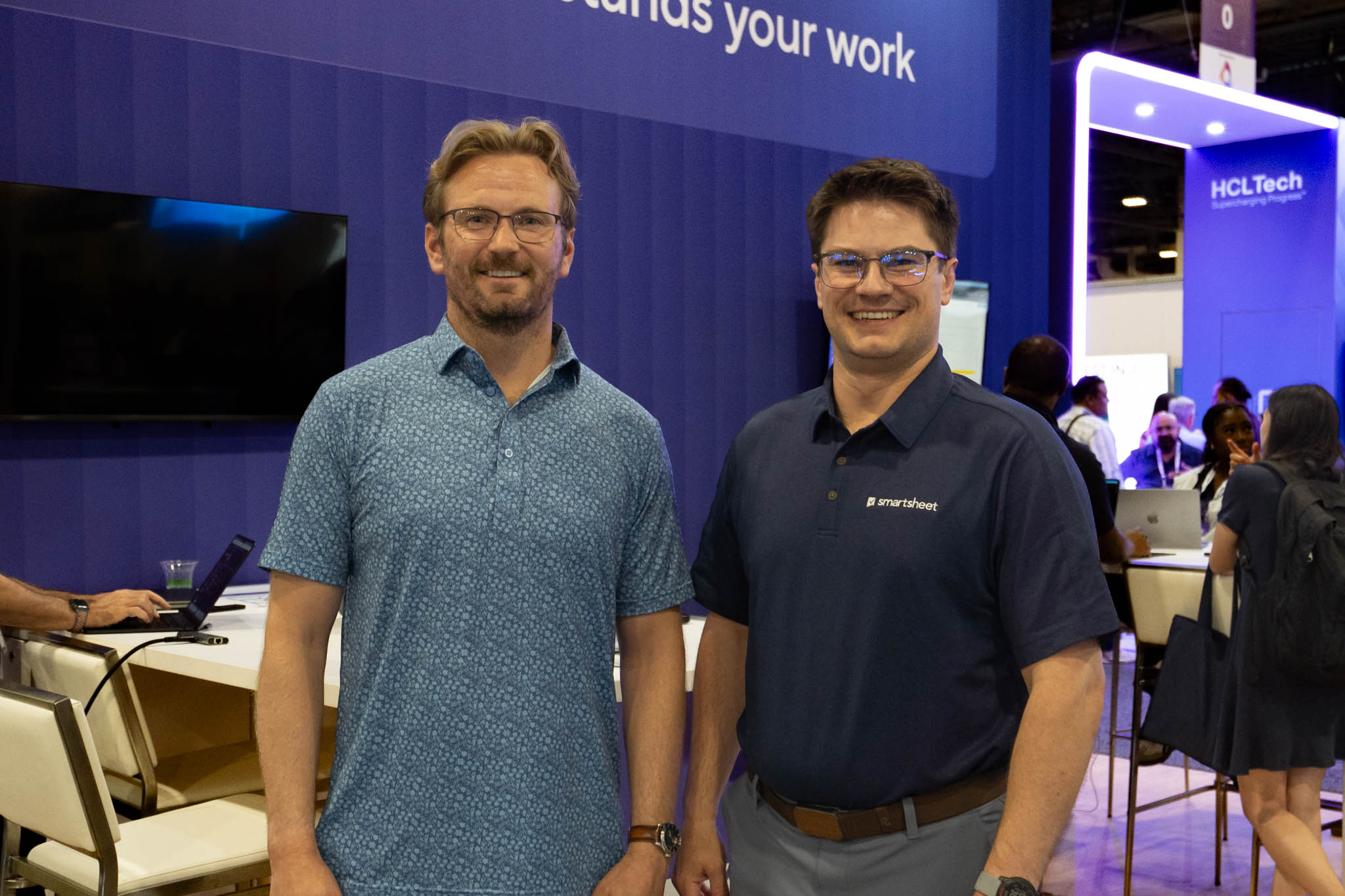
Speaking with Developers.Net CEO Douglas Loyo at Ai4 in Las Vegas, Doug Marshall, an Account Executive for strategic accounts at Smartsheet, and Devyn Heimbeck, a Senior Solutions Engineer, discussed how AI is changing the way work moves through the platform. They also shared how employees inside Smartsheet are using AI in their own jobs.
For Marshall, understanding that transition starts with understanding how work has traditionally moved through Smartsheet.
“Smartsheet historically can do many different things, but use cases would usually include some version of intake and prioritization of work, collaborative execution, and then ultimately having leadership visibility dynamically updated as we’re getting through that work,” Marshall said.
Historically, much of the automation behind those processes has relied on logic-based triggers. A particular action could initiate a request for a status update or alert a leader that an approval was needed.
AI is beginning to change what can happen between those predetermined steps.
Marshall said agentic workflows can increasingly help manage handoffs and move approvals that fall within established parameters. He also said AI can help organizations define what good looks like and benchmark work against it.
The result is a move beyond automating individual actions toward technology playing a larger role in moving work from beginning to end.
Lowering the Barrier to Building
The changes aren’t limited to what happens inside an existing workflow.
Heimbeck said connecting Smartsheet through its Model Context Protocol, or MCP, allows users to work with large language models including Claude, Microsoft Copilot, Gemini and ChatGPT.
For Smartsheet users, one potential impact is reducing the amount of product knowledge required before someone can begin building a solution.
“We have folks who say, ‘I know that I could use Smartsheet to solve this problem, but I don’t have the time to learn which menus to select, how to build out a sheet, how to build a process, how to build a dashboard,'” Heimbeck told Developers News.
He said LLMs can help users understand how to build within Smartsheet. They can also make process improvement recommendations based on the type of work the user is trying to accomplish.
That can help organizations “accelerate that adoption, accelerate the build, and get to that value more quickly,” Heimbeck said.
From Two Weeks to 20 Minutes
Heimbeck is also experiencing those changes directly in his own work.
As a solutions engineer, part of his job involves creating custom demonstrations and proofs of concept to show customers how Smartsheet could address their needs.
AI has significantly changed how quickly he can get there.
Heimbeck said he can now show a customer something that is “80% ready to go” after spending approximately 20 minutes on it instead of potentially spending two weeks building a proof of concept.
LLMs also help him get up to speed on industries and business processes he may not work with every day.
“I need to know generally about everything that businesses do,” Heimbeck said.
Rather than relying solely on his existing knowledge, he said he can use an LLM to better understand industry terminology. He can then incorporate what he learns into the processes he builds for customers.
He sees similar changes occurring elsewhere within Smartsheet.
Heimbeck said account executives and sales development teams can use AI to better understand prospects and existing customers. He also pointed to the pace at which Smartsheet’s engineering teams are developing products.
“I think we’ve probably gone through two years of roadmap in the last six months,” Heimbeck said.
He attributed a significant part of that acceleration to the use of AI tools throughout the company.
Smartsheet Is Using AI, Too
For Smartsheet, developing AI capabilities for customers has also meant learning how to use the technology internally.
Marshall said the company has gone through significant transition in recent years, but described the velocity of new product development during roughly the past nine months as particularly notable.
Smartsheet plans to introduce a new suite of agentic capabilities at its Engage conference in Seattle in November, he said.
But Marshall said offering those capabilities also requires Smartsheet’s own employees to become proficient with the technology.
“For us to be able to offer these things, we also have to get good at them internally,” Marshall said.
He said employees are increasingly adopting AI tools in their day-to-day work. That adoption, he said, is also helping teams become better connected internally.
Finding Knowledge That Was Already There
One of the changes Heimbeck highlighted is finding information that already exists.
Organizations can accumulate years of knowledge across different teams and systems, making it difficult for employees to know what information exists or where to find it.
“You used to have so much siloed knowledge,” Heimbeck said.
He said LLMs have changed the way he accesses Smartsheet’s knowledge repositories.
Instead of knowing where a particular piece of information lives, he can ask whether the company has previously worked with a customer facing a particular situation. He can also explore how different Smartsheet features could work together to address a problem.
“I can find information in ways I never was able to find them before, make connections between those different data sources in ways we couldn’t do before,” Heimbeck said.
The changes Marshall and Heimbeck described reach beyond the AI features Smartsheet is adding to its platform. Employees inside the company are also using the technology to change how they work.
For Heimbeck, that can mean getting a customer demonstration close to completion in minutes rather than spending weeks building a proof of concept. Elsewhere inside Smartsheet, he said AI is helping employees find information that previously may have remained buried within the organization.