

Is it all hype or does AI actually work inside real companies?
Most organizations are not struggling with prompts, but rather, production.
“80% of decisions are made based on your data,” Rahul Dharankar from MarcoPolo said. “LLMs are great at public information. But they don’t have access to your decisions.”
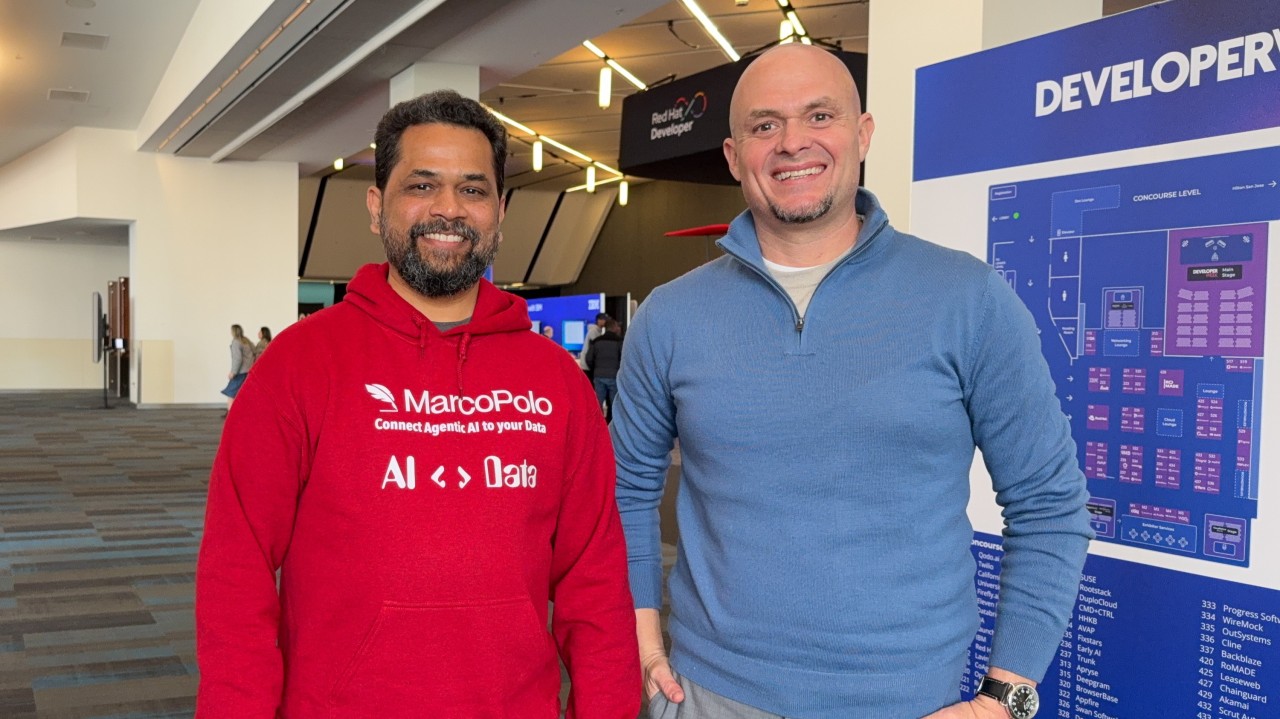
Rahul Dharankar is a multi-time startup founder and operator who has built and exited technology companies, worked deeply in software and open source ecosystems, and now leads AI infrastructure development at MarcoPolo, where he directly addresses the real challenges of enterprise AI adoption
Dharankar says the real value inside a company is not on the internet. It sits in data warehouses, CRMs, ERP systems, ticketing platforms and internal knowledge bases.
Integrating this data, however, causes security teams to be cautious and compliance teams to be nervous.
What data is being accessed? What leaves the environment? Who controls the interaction? How do you manage cost and governance?
Dharankar described the problem in a way that resonated.
“We treat AI like a 16-year-old with a Porsche on the Autobahn,” he said. “As a parent, you want safeguards.”
MarcoPolo’s approach is to create a controlled layer between enterprise data systems and AI agents. The platform connects to more than 50 structured data sources, including Snowflake, Databricks, Amazon Web Services (AWS), Oracle, PostgreSQL and MongoDB, and integrates with AI tools such as ChatGPT, Claude, Visual Studio Code and Cursor.

But instead of pushing raw data back and forth between systems and external models, MarcoPolo introduces intent-based controls and temporary processing environments.
Dharankar described the architecture as creating a controlled execution layer for AI, almost like giving it its own isolated environment inside the enterprise stack. “Processing happens in a controlled environment instead of everything going back to the LLM,” he said. “That reduces token usage and gives you accuracy because it’s query-driven rather than word-generation driven.”
Query-driven interaction means AI is operating against structured logic, not simply generating probabilistic text responses. Temporary environments mean sensitive data does not persist unnecessarily outside enterprise boundaries. Intent controls shift the focus to architecture, allowing leaders to define what AI is permitted to do before it does it.
When AI Adoption Fails
Enterprise AI adoption fails when security teams hesitate, compliance teams slow roll approvals, finance teams question runaway usage costs and engineering teams build custom connectors that are difficult to maintain.
Dharankar believes that friction is predictable.
“We are solving the problems that show up when companies try to move from pilots of AI to actual enterprise adoption,” he said.
That transition is where most organizations stall. Pilots are controlled. Production environments are not. Scaling AI means embedding it inside workflows, not running it beside them.
There is also a deeper philosophical layer to Dharankar’s thinking, one that touches governance and digital ownership.
“You should know whether you own something or whether you’re renting,” he said.
In a world dominated by SaaS platforms and subscription models, enterprises often operate on infrastructure they do not fully control. AI compounds that reality. If the core intelligence layer of your organization is powered by external systems, the boundaries between access and ownership blur quickly.
Where does reasoning happen? Where does data persist? Who defines policy? How do you audit behavior?
Global Engineering Teams
Another key part of our conversation centered on global collaboration. AI may compress development cycles, but it does not eliminate the need for disciplined engineering teams. If anything, it raises the bar for architecture and systems thinking.
“The global potential is what you need to tap into,” Dharankar said. “AI makes that more accessible.”
As AI integrates deeper into enterprise systems, the ability to leverage distributed engineering talent becomes even more strategic. Nearshore and global teams are no longer just cost strategies, but scaling strategies. AI amplifies productivity, but humans still need to define constraints and context.