

When you were little and someone asked what you wanted to be when you grew up, there were answers that felt reasonable, and others that felt a little too out there. Saying you wanted to be a teacher, a doctor, or a firefighter made sense. Saying you wanted to be an astronaut felt closer to saying President of the United States.
Technically possible, sure, but not something you were supposed to actually plan for.
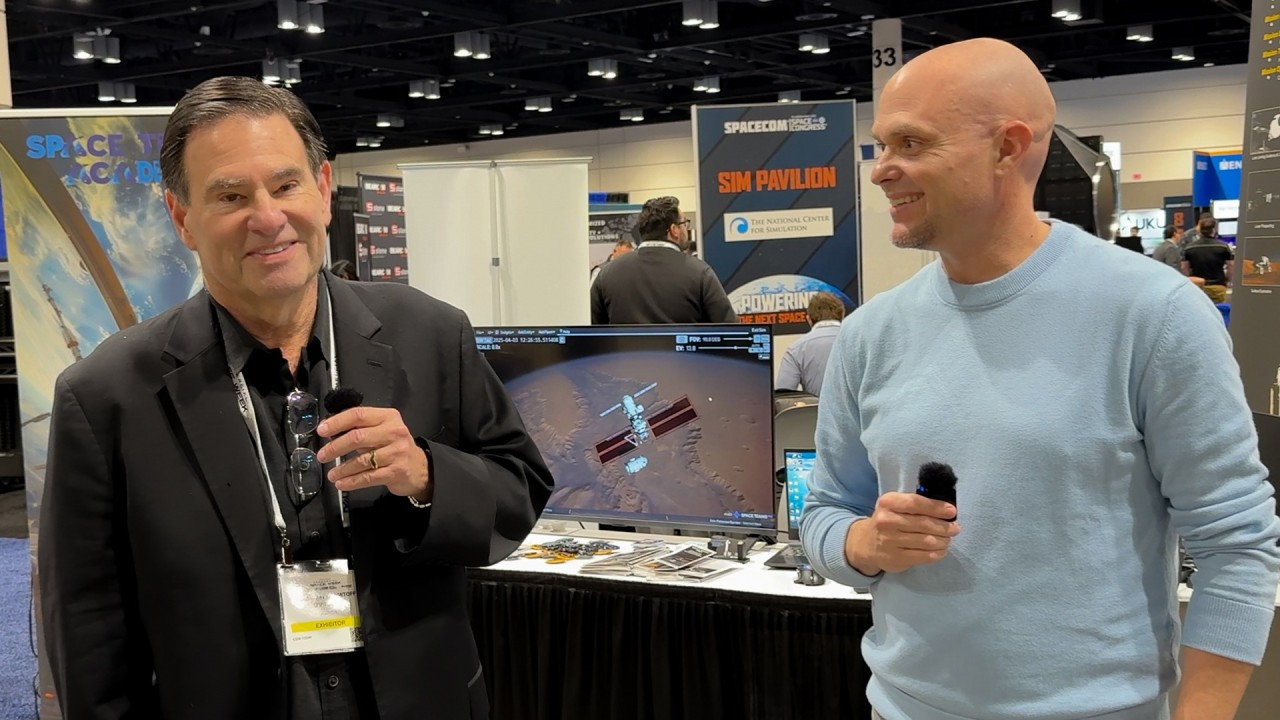
This past week at SpaceCom in Orlando, I had the opportunity to sit down with an actual astronaut who is building technology and educational programs designed to make space travel feel less like fantasy and more like a real path for kids who dream about it.
That astronaut was Gregory Chamitoff.
From an Fantasy Dream to a Real Career
When I asked him about growing up and wanting to be an astronaut, he laughed and shared how different it felt back then.
“When I was a kid, it was embarrassing to say I wanted to be an astronaut,” he told me. “I probably shouldn’t have told my parents, because then they told everyone else.”
At the time, being an astronaut felt like a childhood fantasy, something kids said before real life set in. After achieving what felt like a fantasy, he’s now setting his sights on transforming the industry. One that kids can actually see themselves being part of.
That shift from imagination to possibility, is what drives the work he is doing today.

Building the Technology Behind the Experience
Greg is the co-founder of SimDynamX, a company focused on space mission simulation, training and decision-support technology.
At the core of Sim DynamX’s work is SpaceTeamsPRO, a professional-grade simulation platform that functions as a digital twin of the solar system. It allows users to model spacecraft, missions, robotics, docking, lunar landers, and deep-space scenarios with real physics and real system behavior.
SpaceTeamsPro is designed to be used by professionals, including NASA – National Aeronautics and Space Administration and its contractors, for mission planning, training and evaluating what happens when things do not go as planned.

Built on top of that platform is Space Teams Academy, an educational program that introduces middle and high school students to space mission design. Students learn about space, design missions, build spacecraft, plan trajectories, collaborate virtually and solve problems as a team.
What struck me most is that students can do this from anywhere in the world, often working with teammates they have never met in person.
How the Technology Actually Works
One of the more fascinating parts of Greg’s work is how the technology is structured.
SpaceTeamsPro runs all of its physics, systems, and mission logic internally, ensuring accuracy and realism. For visualization, it integrates with Unreal Engine, which handles the visuals and immersive environments.
In simple terms, the brain of the system is built for accuracy, and the eyes of the system are built for experience.
That combination allows users to step inside complex missions, in VR or on a screen, and experience what it is actually like to operate in space rather than just imagining it.
What Greg Hopes to See Next
When I asked Greg about the future, especially for younger generations, it was all about access.
He hopes to see space continue to move from something people admire as a sort of fantasy to something they can actively participate in as engineers, programmers, systems thinkers, to operators and of course, astronauts.
The more realistic and immersive the experience becomes, the easier it is for people to picture themselves doing the work.
How Space Changed Him
Greg also spoke about how going to space changed his own perspective.
Seeing Earth from orbit did not feel foreign, he said. It felt familiar. Like seeing home from a distance. He described the experience of looking down at a planet without borders, floating in total darkness, and realizing that while Earth itself is not conscious, we are the part of it that can understand and reflect on what it is.