Sovan Bin spent six years inside one of the most well known companies in tech. What he learned while working at Salesforce gave him the tools he needed to build a global team of 150 employees that serves 10% of the global economy.
For most companies, their values exist on a webpage that no one visits. Sovan Bin, CEO and founder of Odaseva, has spent fourteen years making sure that doesn’t happen with his company by instilling a framework he learned from his six years working inside Salesforce.
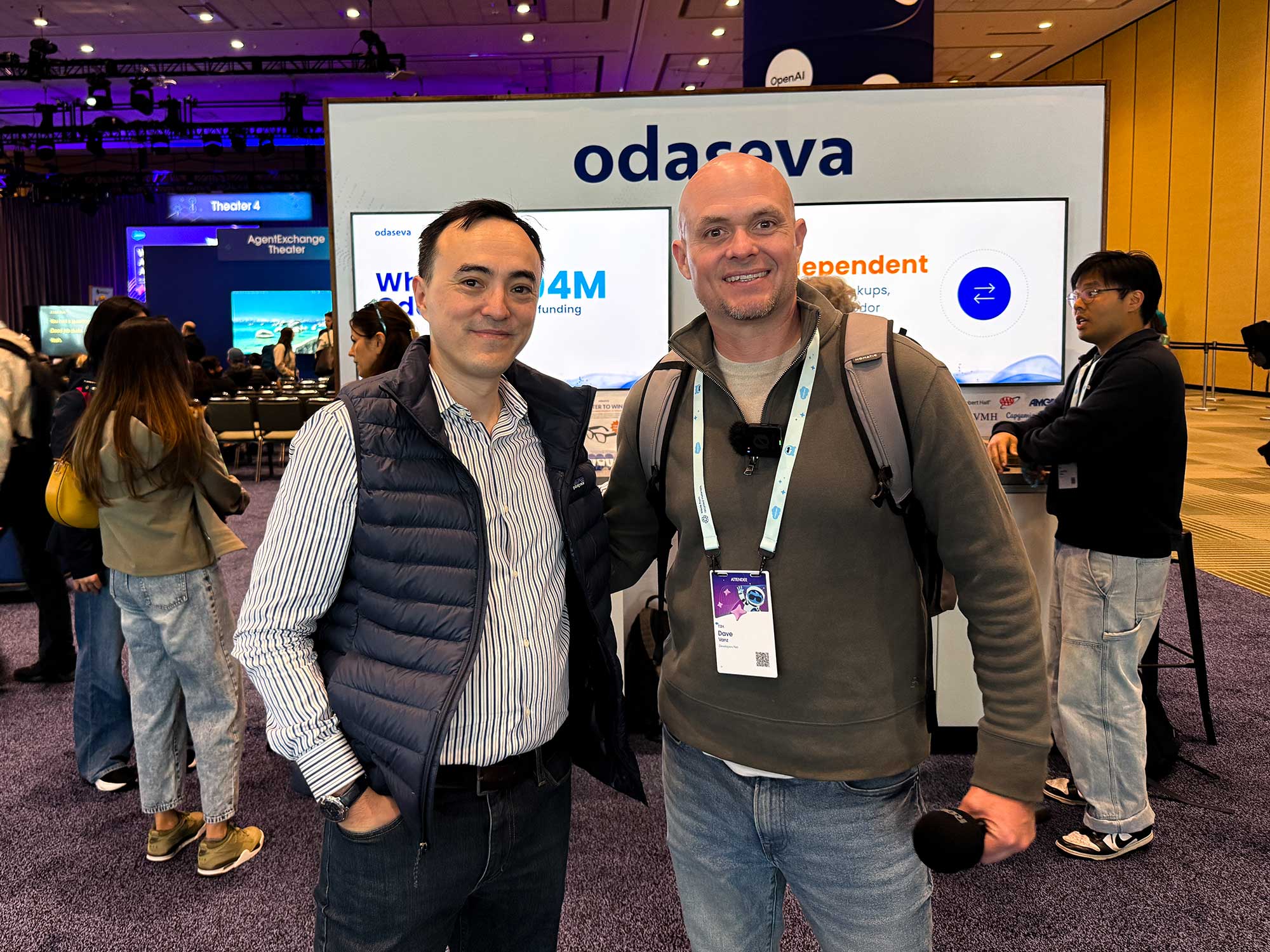
“Salesforce gave me a gift, which I did not realize the greatness of at the time,” Bin said, speaking from the expo floor at Salesforce TDX in San Francisco. That gift was V2MOM, a strategic alignment tool that stands for Vision, Values, Methods, Obstacles, and Metrics. Every Salesforce employee works through V2MOM, annually, and Bin did it for six straight years. When he founded Odaseva in 2012, he included it in his development of the company.
Today, Odaseva protects the Salesforce data of hundreds of the world’s largest enterprises, including Volkswagen, DoorDash, Michelin, Manulife, and Coca-Cola. By Bin’s count, roughly 10% of the global economy runs on their technology. The company operates out of eight hubs across France, the UK, Germany, the USA, Canada, Singapore, Australia, and Malaysia.
To maintain cultural alignment of 150 people across those hubs and three major time zones, can’t be easy, so it was the biggest question I had for him when we spoke. Here’s what he said.
Start with Values and Put them in Order
The V2MOM helps you list your values and then rank them in priority. Ranking helps you decide which value wins when two of them are in tension.
“Many companies come up with values for the marketing sake of it,” Bin told Developers.Net. “‘We are a trust company. We are a customer success company.”
Odaseva places trust at the top, because the business demands it. “We’re in the data security business. If you mess up with trust, you will not be successful.”
Below trust comes Excellence, Engagement, and Seva (a Sanskrit word meaning selfless service to others, and the root of the company’s name itself). Then Kaizen, the Japanese philosophy of continuous 1% improvement. And finally, a belief that collective intelligence always outperforms individual brilliance.
“You can hire the best individual,” Bin said, “but if you don’t have collective intelligence, that individual quality will always be overwhelmed by the group.”
“If you hire the wrong person in the early stage, that wrong person can do serious damage to your culture.”
Hire for Values First
For Bin, it’s imperative to hire someone who fits the culture.
“When you’re a very large company, you prioritize the job description, the specific skills,” he said. “But the smaller you are, whether you’re one person, ten, or 150, like we are today, you prioritize other things. At the beginning, embracing the values was the number one thing I looked for.”
Now at 150 people, values still lead.
Federate Around the Framework
With eight hubs and remote employees layered across each, proximity can never be the glue. The V2MOM serves that role instead. “We federated with the V2MOM first,” Bin said. Before any of the operational work of running a global team, there has to be alignment on who you are, what you believe, and why it matters.
That’s the foundation and the operational layer sits on top of it.
Odaseva holds monthly meetings with rotating time slots so no single region always takes the inconvenient hour. They do fireside chats designed to surface feedback and create dialogue, and Slack serves as the connective tissue across time zones. Bin also said he invests his time in flying people to the hubs to work so they can physically experience the culture of the company.
“It’s not just about sharing what’s going on in the group,” Bin said. “It’s listening, sharing feedback, having an open door.”
“The first thing I did on day one was work on the values. At the time, I was the only one in the company, but I knew that would change.”
Culture as a Competitive Advantage
Bin sees the connection between culture and client outcomes as direct and unambiguous.
Odaseva serves some of the most demanding technology buyers in the world. Organizations that have gone all in on Salesforce, are subject to stringent data regulations like GDPR, and need a partner they can trust with their most critical systems. The white glove service they receive emerges from a team that actually believes in what they’re doing.
“Imagine the experience you get in a Louis Vuitton store,” Bin said. “Because we work with the largest enterprises in the world, we welcome them in our store. We have to have that level of service.” That standard, he argues, can only be maintained if the people delivering it are genuinely aligned with the values behind it.
This alignment starts with a framework borrowed from a company that has been practicing it for 25 years. It’s refined through prioritization, protected through hiring discipline, and sustained through a deliberately designed operating rhythm. Six years inside Salesforce taught Bin that culture is the architecture to building a great company.