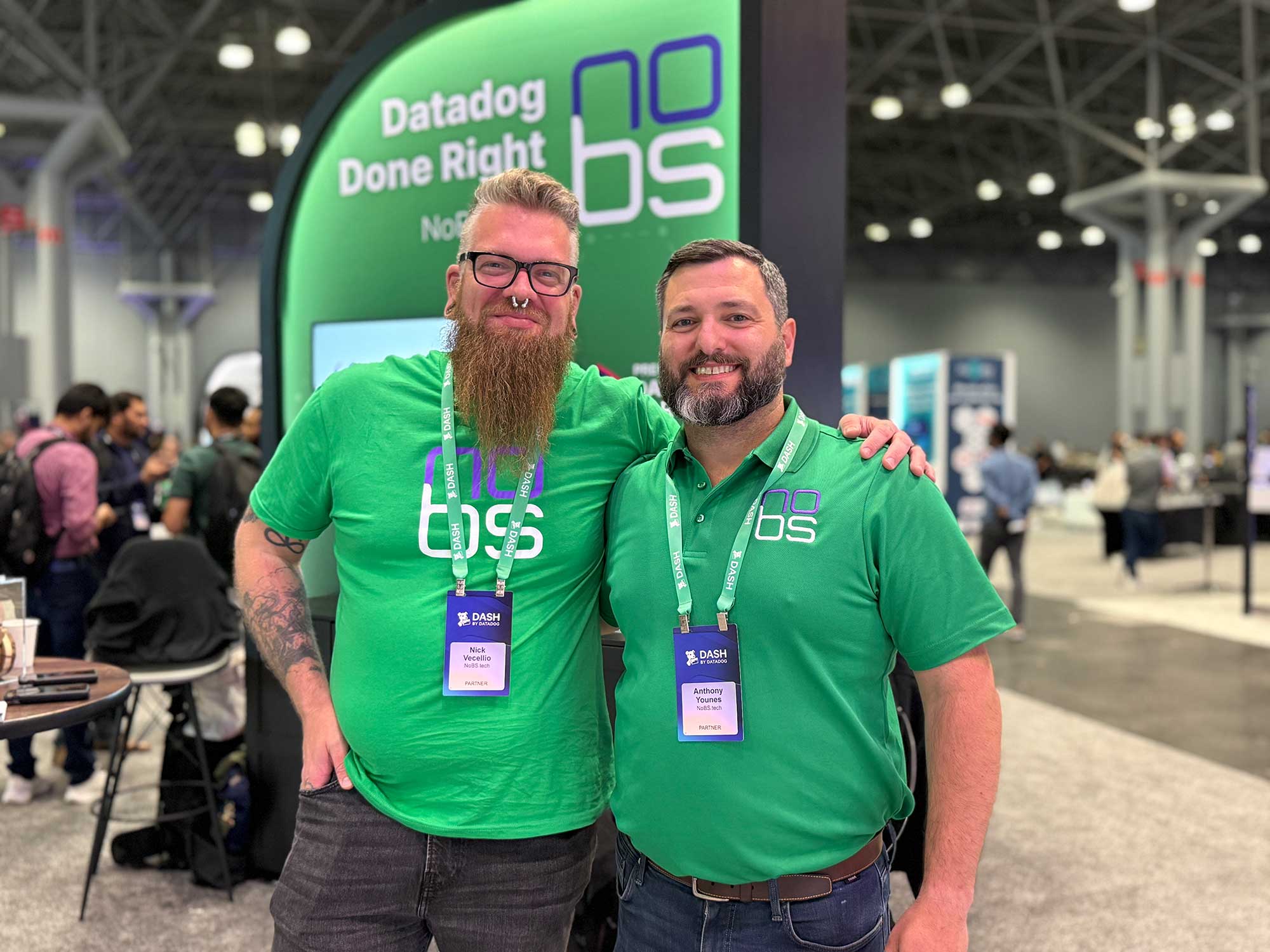
In a business world filled with corporate buzzwords, lengthy meetings, and carefully crafted messaging, the name feels almost rebellious. (and I love it) For co-founders Nick Vecellio and Anthony Younes, the name reflects the culture they have intentionally built from day one.
NoBS consulting firm, which works exclusively with Datadog customers, was recently recognized as Datadog’s 2026 Partner of the Year – Rising Star Partner, an award presented during the company’s annual DASH conference in New York City. The recognition comes just two years after NoBS launched in early 2024.
Before becoming business partners, Vecellio and Younes worked together and developed a strong professional relationship. When Younes decided he wanted to start a company, he knew he needed a technical counterpart. Vecellio, who had been encouraged by others to start a business for years, wasn’t initially convinced entrepreneurship was for him. Together, however, the partnership made sense.
“Nick needed the business side, and I needed the technical side,” Younes said.
The company’s name was born from a frustrating experience Vecellio had while working with another organization. A relatively small project kicked off with an 8 hour meeting involving dozens of people and an overwhelming presentation deck. Sitting through the meeting, he found himself thinking there had to be a better way.
He texted Younes with an idea.
“The name of the company is NoBS.”
Younes’ response was immediate.
“Yes, it is.”
The name reveals something important about the organization’s culture. NoBS was built around a simple philosophy: eliminate unnecessary complexity, communicate clearly, and focus on outcomes.
That mindset has become especially important as the company has grown as a fully remote organization. During a conversation at DASH 2026, Younes and Vecellio shared three principles that have helped them build a connected, productive culture in a remote environment.
Be Open and Direct About Expectations
According to Younes, one of the biggest challenges of running a remote company is maintaining culture.
Without the benefit of daily in-person interactions, assumptions can quickly create misunderstandings. That’s why NoBS establishes expectations before an employee even joins the organization.
“We’re very direct and open in terms of expectations and what to expect when you start with us,” Younes explained.
One expectation stands above the rest: employees must be comfortable with direct feedback.
At NoBS, feedback is not viewed as criticism but as a necessary part of growth and accountability. Team members are expected to communicate openly with one another and address issues directly rather than allowing frustrations to build.
The focus is to build a healthy culture by not avoiding difficult conversations. For people to know what is expected of them and trust that feedback is being given with positive intent.
Practice MRI: Most Respectful Interpretation
One of the most practical ideas discussed during the interview was something Younes calls MRI, which stands for Most Respectful Interpretation.
The concept is especially relevant for remote teams because so much communication takes place through Slack messages, emails and chat platforms.
Written communication lacks tone, facial expressions, and context. A message intended to be helpful can easily be interpreted as criticism. A short response can feel dismissive when the sender was simply busy.
MRI encourages employees to pause and assume the best possible intent behind a message before reacting.
If a teammate sends a message that feels abrupt or uncomfortable, the first question becomes: “What is the most respectful way I can interpret what they meant?”
By creating this habit throughout the organization, NoBS reduces unnecessary conflict and prevents employees from making negative assumptions about one another.
In many ways, MRI serves as the foundation that allows direct communication to work. Teams can be honest and transparent because everyone understands that feedback is being delivered with the intention of helping, not hurting.
Hire for Character and Curiosity
Many companies hire primarily for technical skills.
NoBS certainly values expertise, but Vecellio believes character traits are often more important than any specific technology someone already knows.
In fact, two qualities he looks for initially sound counterintuitive.
He likes people who are “lazy” and people who get bored easily.
Of course, he doesn’t mean employees who avoid work or lack motivation.
A “lazy” engineer, in his view, is someone who dislikes repetitive tasks and immediately starts looking for ways to automate them. Instead of performing the same work over and over, they create systems and processes that make the entire team more efficient.
Likewise, people who become bored easily tend to be lifelong learners. Once they master a skill, they are already searching for the next challenge.
Combined, those characteristics create a culture of continuous improvement.
Employees are constantly learning, documenting, automating, and sharing knowledge with one another. They help each other solve problems because everyone understands that the organization’s success depends on collective growth rather than individual expertise.
Culture Without the Fluff
Technology can connect employees, but software alone cannot create culture. As Younes and Vecellio have demonstrated, principles may be simple, but simple doesn’t mean easy. It requires commitment, consistency, and a willingness to eliminate the unnecessary.
In other words, it requires a little less BS.