For more than 20 years, Voices has built its business around the power of the human voice.
Founded in 2005, the company has connected brands and agencies with voice actors for advertising campaigns, podcasts, promotional materials and other projects. But as artificial intelligence has rapidly changed how companies create content and interact with customers, Voices has found itself answering a new question: When should a voice be human, and when should it be AI?
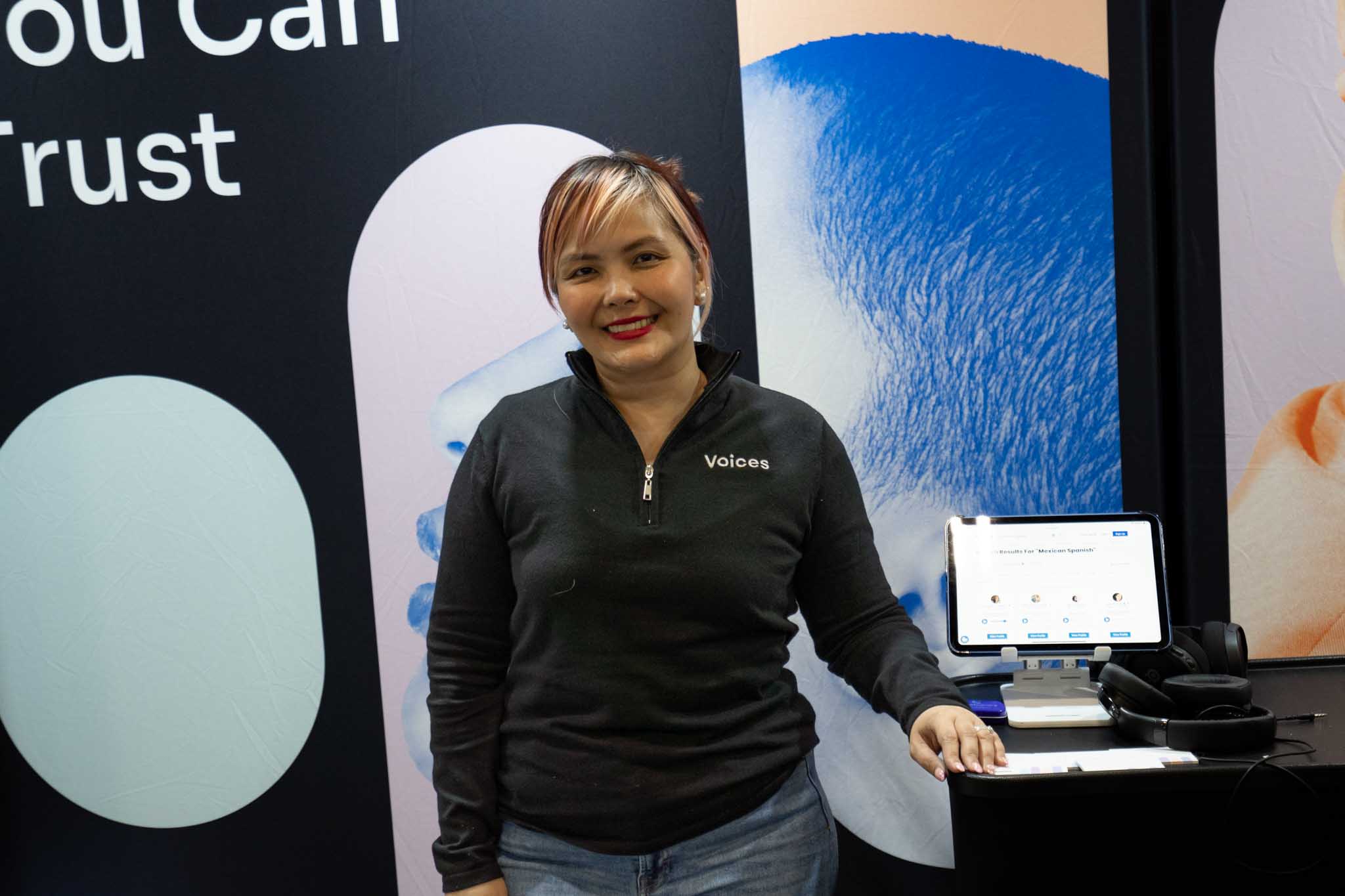
Belle Baldoza, Director of Brand and Field Marketing at Voices, said the company has seen growing demand for both voice data and AI-generated voices over the past several years.
That demand has pushed Voices beyond its roots as a traditional voiceover marketplace. Today, the company operates across three areas: traditional voiceover, voice data and AI voice.
“We saw that in the last couple of years, we’ve seen that demand grow,” Baldoza said. “And so that really led to us evolving as a voice solutions platform.”
Knowing When AI Is the Right Voice
As AI generated speech becomes more and more realistic, choosing a voice may seem like a technological decision. Baldoza said Voices is increasingly helping customers understand that it can also be a human one.
The company works with clients to determine what a particular project requires and whether an AI generated voice or traditional voice actor is better suited for it.
“We know when an AI voice would work best, but also where a traditional voiceover would be more impactful,” Baldoza said.
The distinction can become particularly important in industries that connect with customers often.
Baldoza pointed to customer service, health care, education and e-learning as examples where the way someone responds emotionally to a voice can matter as much as the information being communicated.
“There is nothing that can replace a human voice with its own nuances, its own quirks,” Baldoza said. “It’s not just important that a voice sounds real, but actually it’s more important how this voice makes you feel.”
That distinction could become increasingly significant as businesses deploy AI agents and automated systems in more customer-facing interactions.
An artificial voice may be capable of delivering the right words. The larger question is whether delivering those words is enough.
The People Behind AI Voices
The expansion of generative AI has also raised questions throughout the creative industries about how human work is used to train AI systems.
For voice actors, those questions can be particularly personal. A person’s voice is not simply a piece of content. It is an identifiable part of who they are and, for professional voice actors, part of how they earn a living.
Baldoza said Voices only collects voice data that professional talent has consented and agreed to provide, and that the data is used for the purposes of the project for which it was collected.
That approach reflects the unusual position Voices occupies as AI transforms the industry. The company is building a business around AI voice while continuing to represent a global talent base of professional voice actors.
For Baldoza, that connection to the human side of voice was part of what attracted her to the company.
Before building a career in public relations and marketing, Baldoza worked as a rock radio DJ during her university years. She later took on freelance voiceover projects while developing her career.
“I already understood the power of the human voice,” Baldoza said, pointing to its role in storytelling, influencing outcomes and defining how a brand communicates.
A Voice Company Before AI
While AI has created new opportunities for Voices, Baldoza is quick to distinguish the company from businesses that emerged during the recent generative AI boom.
“We’re not just an AI voice company,” she said. “We are a total voice solutions platform.”
Voices’ history predates the current wave of generative AI by nearly two decades. That experience means the company’s evolution isn’t simply about creating increasingly realistic artificial voices.
It is also about understanding when technology should be used and when the qualities of an actual human voice still matter.