At more than 115 years old, the Petaluma Creamery still stands in downtown Petaluma as a reminder of the agricultural history that helped shape Northern California. Inside the historic creamery, milk still arrives daily and cheese is still produced at scale. Generations of dairy tradition still moves through the building.
And now, AI does too.
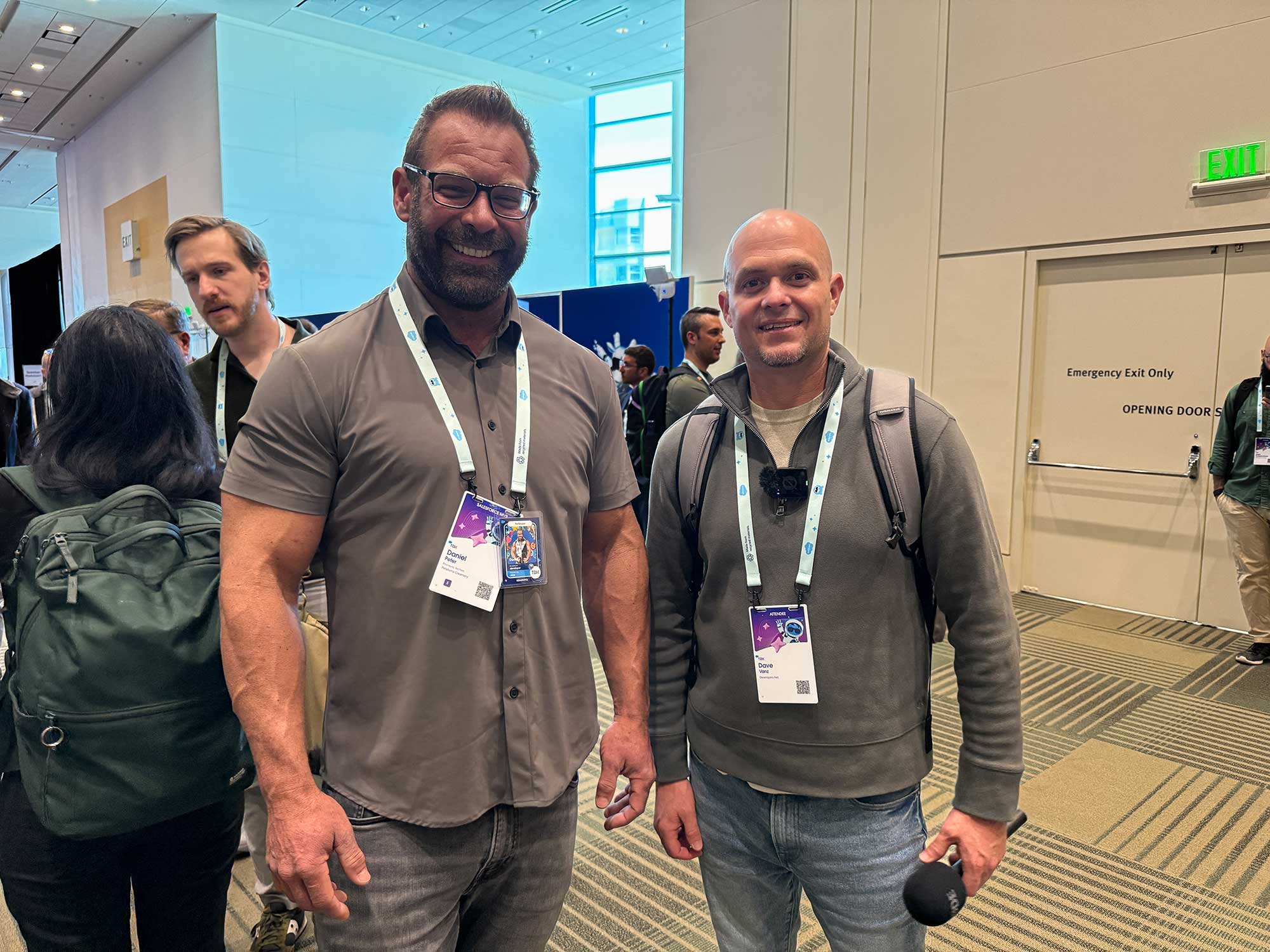
Meet Daniel Peter, CTO of Petaluma Creamery. I first met Daniel during one of the evening concerts at TDX while we were both front row for The All-American Rejects. Daniel was right next to me as I was completely eves dropping while he talked to someone about working for a creamery and using AI to help keep the business alive. A 115-year-old dairy operation embracing AI? That isn’t exactly the kind of story you expect to hear at a major tech conference. I had to butt in.
I never got Daniel’s contact info at the concert but I ended up running into him at the expo just as we finished interviewing Sovan Bin from Odaseva.
Diving Deeper into Petaluma Creamery
According to the creamery, the facility can produce up to 140,000 pounds of cheese per day while manufacturing multiple classes of dairy products. The company produces butter, cheese, ice cream, whey, milk powder, and organic dairy products using milk sourced from Northern California dairies.
According to the company’s website, Petaluma Creamery was established more than a century ago and remains tied to the agricultural identity of the region. Larry Peter, a Sonoma County native and cousin to Daniel, purchased his first cows in 1987 before eventually acquiring the creamery in 2004, helping preserve a historic part of Petaluma’s dairy industry. The company’s herd of Jersey cows is pasture-access, non-GMO and hormone-free.
History, though, doesn’t guarantee survival.
“The challenge there is the cost of living is so high now in the town of Petaluma,” Daniel said during our interview. “Most of the dairies and creameries have moved out.”
Despite Petaluma being one of the strongest dairy regions in the country because of its geography and climate, operating there has become increasingly difficult. Daniel explained that the creamery is one of the last remaining operations still holding on in the area.
How Petaluma Creamery is Using AI
Daniel currently serves as Chief Technology Officer for Petaluma Creamery, bringing with him a background deeply rooted in the Salesforce ecosystem. Before joining the creamery’s modernization efforts, he spent years working with Salesforce technologies and even served as an Advisor for Salesforce’s startup accelerator program between 2018 and 2024, mentoring fintech startups across the EMEA region.
Now, instead of applying those skills solely to startups or enterprise software companies, he is applying them to a historic dairy manufacturer trying to reinvent itself.
“My cousin, Larry Peter, came and found me and asked for my help,” Daniel said. “He wanted to put all of his paper-based and antiquated digital systems into Salesforce and start using AI because he can’t afford to hire hundreds of people anymore to do the work.”
The transformation began by moving operations into Salesforce and building AI-powered workflows using Salesforce Agentforce. From milk receiving temperatures and production tracking to invoicing and ordering systems, the creamery started digitizing decades of operational data.
Then, one of the biggest early breakthroughs came through predictive ordering.
Because the company imported more than 20 years of invoicing history into Salesforce, AI can now analyze customer purchasing behavior and predict future orders with surprising accuracy.
“We can basically click a button,” Daniel explained, “and generative AI can tell us what it thinks they’re going to buy for the next order, and generally it’s pretty close.”
The technology is helping the creamery do more with fewer people while still preserving the human relationships that define the industry.
Daniel noted that many grocery buyers still prefer speaking directly with people instead of AI agents. Rather than rushing toward fully automated interactions, the creamery is taking a more conservative approach by using AI to assist employees behind the scenes instead of replacing personal conversations entirely.
That balance between technology and human connection became one of the most interesting parts of our conversation as the goal is to remain a creamery, not become a tech company.
AI simply became the tool helping a historical, traditional business, survive.
How AI is Impacting Petaluma Creamery
Daniel shared that the creamery previously relied on a much larger sales team. Today, one salesperson is managing approximately 300 stores through Salesforce while helping the company work toward re-entering 2,500 locations.
“That’s something like a 5X efficiency improvement,” Daniel said. “One person is doing the work of a five-person sales team.”
Daniels focus is on how technology can be used to preserve places and industries that might otherwise disappear.
“You hear a lot about AI killing jobs,” he said. “But the other thing it’s doing is it’s allowing industries that would’ve went away to reinvent themselves and basically still exist so future generations can see some of the history of these neat towns in America.”
That perspective is what made Petaluma Creamery’s story stand out so much to me.
In a world where AI conversations are often centered around billion dollar software companies, automation fears, and digital disruption, this is a story about using technology to preserve heritage, manufacturing, agriculture and community identity.